

The $57 Billion Question: Can MENA's Supply Chain Keep Pace With E-Commerce Growth?
The forecast has become the present. MENA's e-commerce market was projected to reach $57 billion by 2026, and that milestone is no longer on the horizon; it is here, driven by accelerating digital payment adoption, a wave of cross-border trade reforms, and a demographic majority that treats online shopping not as a novelty but as a default.
Yet a market arrival is only as meaningful as the infrastructure standing behind it. And in MENA, that infrastructure- the logistics and supply chain networks responsible for turning a completed checkout into a delivered parcel is still catching up.
Growth without fulfilment capability is not growth. It is lost revenue, abandoned carts, and customers redirected to whoever can actually deliver. The $57 billion ceiling only becomes a floor when the region's supply chain is built to hold it.
Plugging Supply Chain Gaps: The Defining Challenge of the Decade
Consumer expectations in e-commerce have been set by the world's most sophisticated fulfilment operations, and those expectations do not adjust for regional infrastructure constraints. Same-day delivery windows, granular shipment tracking, seamless return processes, and flexible last-mile options are no longer differentiators. They are baseline requirements that any retailer competing online must meet.
Plugging supply chain gaps in MENA means closing the distance between that baseline and what regional logistics networks currently deliver at scale. That is not a single intervention. It is a coordinated effort across several interdependent dimensions: last-mile reach into secondary and tertiary markets, consistency in customs processing times, warehouse positioning relative to demand centres, carrier network reliability, and the data infrastructure that makes all of it visible and manageable in real time.
None of these can be addressed in isolation. A world-class fulfilment centre that feeds into an unreliable last-mile network still fails the customer. Rapid customs clearance becomes irrelevant if inventory positioning is wrong. The supply chain functions as a system, and it performs at the level of its weakest node.
The businesses that recognise this systemic reality early, and act on it, will not simply survive MENA's e-commerce expansion. They will be the ones setting the pace.
A Market in Full Surge — Is the Infrastructure Keeping Up?
The commercial case for MENA e-commerce is no longer built on speculation; it is being validated in real time. The building blocks of a mature digital commerce market have assembled across the region with remarkable speed.
Mobile wallet penetration has climbed sharply across the Gulf states, Egypt, and North Africa, dismantling one of the most persistent barriers to online transaction growth. Free zone expansions and bilateral trade agreements have reduced the friction historically associated with cross-border commerce in the region. And the demographic profile of MENA, where more than 60% of the population is under the age of 30, represents precisely the consumer group that has driven e-commerce growth everywhere else in the world.
What makes this moment significant is also what makes the infrastructure challenge urgent. A generation raised on platform commerce does not recalibrate its expectations downward because a regional logistics network has not caught up. It shops elsewhere. For local and regional businesses, this is the central competitive tension: demand is fully activated, but the operational capability to serve it consistently, at speed, at scale, across complex geographies, is still developing.
The supply chain, long treated as a back-end operational concern, has moved to the centre of the competitive equation.
Where the Gaps Are Hiding
Not all of MENA's logistics vulnerabilities are equally visible, and misidentifying where the real constraints lie leads to misallocated investment.
Last-mile delivery absorbs a disproportionate share of logistics cost and customer dissatisfaction. Across much of the region, address standardisation remains inconsistent, delivery time-window management is underdeveloped, and the carrier ecosystem outside major urban centres is fragmented. The result is a final leg of the journey that undermines the efficiency of everything that preceded it.
Cross-border movement carries friction that varies significantly by corridor. Customs clearance that takes hours on one trade lane may take days on another, with limited transparency into the cause or the timeline for resolution. For businesses managing multi-market inventory, this unpredictability makes planning difficult and customer communication unreliable.
Disconnected technology systems represent a less visible but structurally significant problem. A large proportion of regional businesses still run warehouse management, carrier communication, customs documentation, and demand forecasting on separate platforms with no live data exchange between them. Information is reconciled after the fact, which means that by the time a problem surfaces in the data, it has already impacted operations. A supply chain that cannot see itself cannot improve itself.
The Digital Route: Cloud, APIs, and Real-Time Visibility
The distinction between a traditional logistics operation and a digital one is not the presence of technology; it is the degree of integration. A genuinely digital supply chain connects every operational node into a unified information environment where data flows continuously, decisions are informed by real-time conditions, and exceptions are flagged before they escalate into failures.
The technical foundation for this is a combination of cloud infrastructure and open APIs. Cloud platforms remove the processing and storage constraints of legacy on-premise systems, enabling logistics data to be captured, shared, and acted upon across geographies and time zones without latency. APIs create the connective tissue between previously siloed applications, allowing a warehouse management system to communicate live inventory positions to a carrier dispatch platform, which feeds into a customs pre-clearance portal, which updates a customer-facing tracking interface in real time.
Layered on top of this connectivity, these capabilities are now actively delivering genuine predictive intelligence across leading logistics operations. Machine learning models trained on historical shipment data identify patterns that precede delays, allowing rerouting decisions to be made before a disruption compounds. Predictive demand analytics reduce the reactive nature of inventory replenishment. IoT sensors embedded in shipments provide condition data throughout transit, not just a location timestamp, but a continuous record of temperature, humidity, and handling events.
These are not aspirational technologies awaiting future commercial deployment. They are embedded in how the best logistics networks operate today. The variable is adoption, and in MENA, the businesses that have prioritised this integration are already building an operational advantage that will be difficult for later movers to close.
What an End-to-End Logistics Provider Actually Delivers
Managing logistics as a set of disconnected vendor relationships- one partner for warehousing, another for transportation, a third for customs brokerage- distributes accountability in a way that serves no one well. When something goes wrong across a multi-vendor chain, identifying where responsibility lies is slow, and resolution is slower.
An end-to-end logistics provider consolidates that accountability into a single relationship. One partner owns the full movement of goods from point of origin through to final delivery, with visibility and performance responsibility at every stage in between. In the MENA context where a single shipment may cross multiple jurisdictions, involve several handoff points, and require coordination between local and international carriers, that unified accountability is not a convenience. It is a meaningful operational advantage.
There is a second-order benefit that is easily overlooked: capability continuity. When a supply chain company invests in a new technology platform, extends its carrier network into a new market, or develops expertise in a new regulatory environment, every client relationship in its portfolio benefits. Businesses that would not individually have the scale to access these improvements receive them as a function of the partnership.
The Businesses That Will Win
The e-commerce opportunity in MENA is no longer a question of if — it is a question of who. Capital has flowed in, platforms have scaled, and consumer appetite is demonstrably real. The market has arrived.
The open question is who captures the growth.
In a high-velocity market, product alone does not determine winners. Execution does. The businesses that can fulfil an order accurately, deliver it on time, handle the return gracefully, and do all of this consistently across a region as geographically and regulatorily diverse as MENA- those are the businesses that build the kind of customer loyalty that compounds.
A resilient, technology-integrated supply chain is the operational backbone of that execution capability. Plugging supply chain gaps is not a logistics department initiative. It is a strategic leadership decision, one that determines whether a business is positioned to lead MENA's e-commerce decade or watches it pass from the outside.
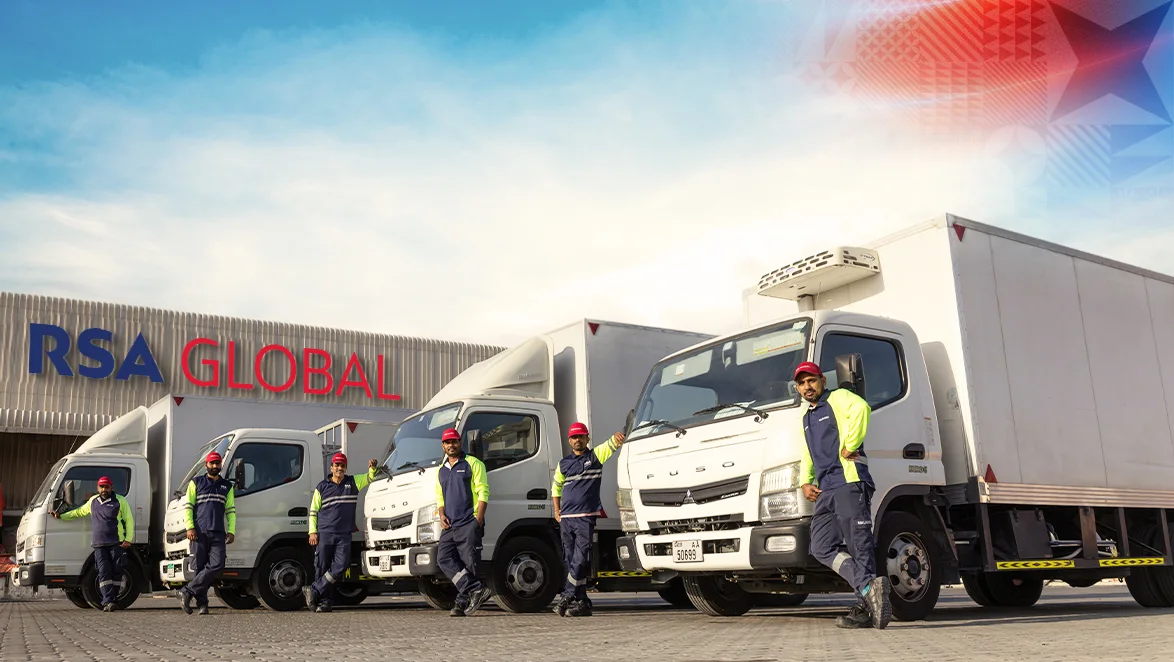
RSA Global partners with businesses across MENA to build resilient, technology-driven supply chains that scale with commercial ambition. Speak to our team about how we can support your growth.


